Showing posts with label memoir. Show all posts

Tuesday, March 29, 2011

Call Me Mom

This memoir contains two stories for me - how I acquired the work and the tale it tells.

On December 4, 2010 I attended a St. Nicholas Day celebration in the City. St. Nicholas Day is the traditional day of celebration and gift-giving during Holland's Christmas season. It was at this celebration that I met Fred van Zuiden.

van Zuiden, the author of Call Me Mom: A Dutch Boy's WWII Survival Story, had scheduled a book signing during the City's annual celebration. When I met him I was intrigued by his past experience as a Jewish boy in Holland during World War II. He seemed like a charming man, he signed the book, and we said goodbye. van Zuiden is the first (of now many) Jewish Holocaust survivors that I have had the pleasure of meeting. I know I will never forget him and his story.

The signed copy.

Sunday, February 20, 2011

Book Blogger Hop

Book Blogger Hop

This week on Jennifer's Crazy-For-Books Book Blogger Hop, she asks: "What book(s) would you like to see turned into a moive?"

A: I had to think long and hard about this question. So many of my favourite books have already been translated into film-form. The Notebook? Done. Harry Potter? Way, way done. There are so many Holocaust movies. My favourite fairy tales? Disney's taken care of that.

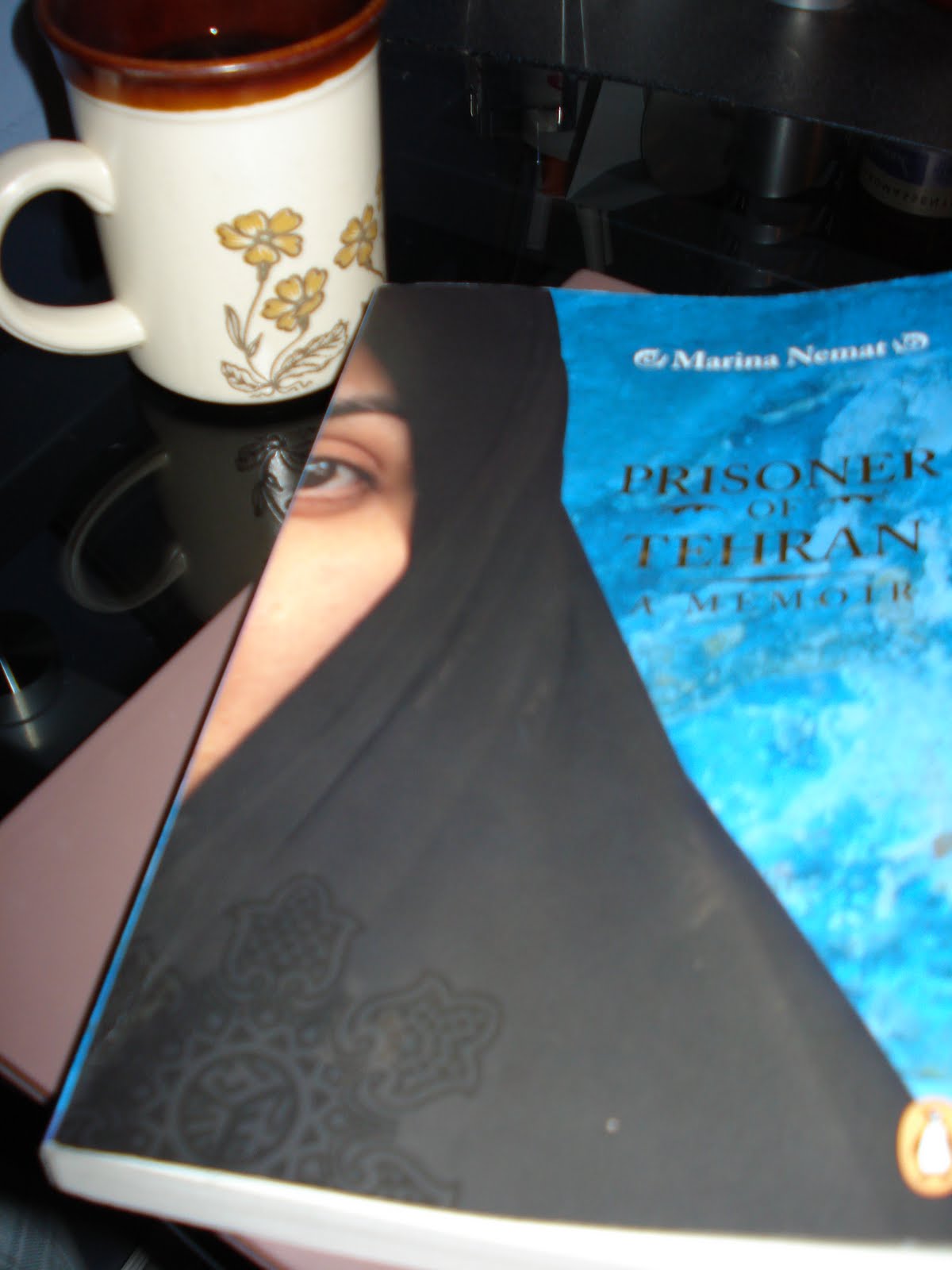
So, the one book I'd love to see as a movie? I'm going to have to go with Prisoner of Tehran: A Memoir by Marina Nemat. This book was extremely powerful and unforgettable. It tells the tale of a young Iranian girl who is wrongly imprisoned in Tehran for performing activities against the Iranian state. Nemat's work was the first book I blogged about - in a way, the passion and excitement of this book led me to the blogging world. It is definitely a book to be read and one that would make a fine movie.

Tuesday, July 20, 2010

The Girl in the Red Coat

My friend K and I enjoy exploring metro-Vancouver on the days we have off from work or studies. Typically we venture to the mall, spend countless hours wandering and shopping, and go home with at least a few books. Recently, we've decided to broaden our trips to include Robson Street and visits to the Vancouver Public Library.

Let's start off by saying it's a beautiful library... see?


It's Vancouver's version of a little Coliseum. Upon entering the library you receive shopping baskets and a map. It's that big. Last Thursday I spent most of my afternoon on the 6th floor - the History section - and left with eight books.


Roma Ligocka's The Girl in the Red Coat was the last book I decided to take home... and ironically the first book to be discussed on C.T.R. But where to start?

I'm assuming most people have seen Schindler's List. I remember the first time I saw it in a social studies class during high school. The film is dominated in black and white imagery besides one scene - that of a little girl in a red coat. In case you don't remember or by chance have not viewed the film (in which case I highly recommend you do!) here's a youtube clip.

Ligocka, a Jewish survivor of the Holocaust, claims to be the real little girl in this clip. Born in 1938, the first years of Ligocka's life were spent in a Polish ghetto with her father, mother, and grandmother. Ligocka claims to have worn a bright red coat alike to the little girl portrayed in Spielberg's film. Ligocka recognizes her family members in the film - the murder of a Jewish engineer and a couple who marry in Auschwitz reflect her own family's experiences in the Holocaust.

It seems like Ligocka is attempting to give Spielberg's work authority throughout her memoir. Yet, the similarities between Ligocka's and Spielberg's stories suggest to me that the Holocaust is overall generalized to far too great an extent.

Generalizing the Holocaust does create the opportunity for audiences to relate to the portrayed characters and begin to comprehend, at least a little bit, the horrors endured during the Second World War. Generalizing the Holocaust also permits people to have a cursory glance at the subject, to say that they will remember, but to fail to acknowledge the full diversity of the experience. Generalizations suggest that there is one story and thus removes and suppresses individual voices.

At times Ligocka's story is hard to believe. How can she remember events from her early childhood? How can she recall conversations, sequences of events? I suppose this can be attributed to artistic license. Yet doing so removes the sense of authenticity from her work.

Perhaps my strong dislike for generalizations is why I enjoy memoirs. Once I overlook Ligocka's views on Schindler's List her work becomes much more enjoyable. Ligocka's personal experiences are vivid. Her writing oozes descriptions that come to life - bed bugs, her first taste of chocolate, meeting her father after his escape from Auschwitz, ill-kept Jewish cemeteries, and Jewish schoolchildren who cry and flinch in class after the close of war.

Ligocka's work is most profound due to her focus on the psychological impact of the Holocaust. Ligocka adeptly illustrates the survivors' desire to not speak of their experiences, to turn away from the past, and (for some) to resort to addictions to alcohol and prescription medication.

Overall, The Girl in the Red Coat tells the story of Poland under fascist and communist dictatorship, portrays a woman's lifelong struggle to find self-acceptance, and urges one to not turn their back on the past. It is an interesting memoir but not one of the most enthralling pieces of Holocaust literature.

Friday, July 16, 2010

Prisoner of Tehran: A Memoir

During my first cup of coffee this morning I thought it was high time I post a review. I've read a couple of books this week... one pointless, frivolous, and lacking a strong plot line (just as a romance novel should be haha)... and another that was immensely powerful.

It's been a few days since I finished reading Marina Nemat's Prisoner of Tehran: A Memoir, but it is still vivid in my mind. Typically I read a book in a day or two. I've been reading Nemat's work on and off since late May although it is a page turner, suspenseful, and relatively short at just under 300 pages. I've been a busy girl, but the fact that Nemat's writing called me back after a month long hiatus is a pretty good testament to its value.

Nemat tells the story of her life in Iran. Nemat, then a 16 year old girl, was imprisoned by the Iranian Revolutionary Guards in 1982 and tortured for two and a half years under a false charge of conspiracy against the Ayatollah Khomeini government. She provides accounts of her childhood in Tehran, the change of rule from Reza Shah Pahlavi to Ayatollah Khomeini, in-depth backgrounds on the lives of her fellow female inmates in Evin, and the psychological and physical torture she endured both inside the prison's walls and in her own family after her release.

Though this memoir could have been extremely negative, and in parts it is, Nemat does an adequate job in illustrating that despite everything she encounters Iran remains an integral part of her and her concept of home. Yes, the memoir is littered with descriptions of repression, torture, suicide, rape, and murder... but Nemat also portrays fond memories of life in Iran - visiting her family's summer cottage, falling in love, parties, and the birth of children. She expresses sadness at the thought of her own children never knowing Iran, never being able to see her country's beautiful landscape upon her emigration. In this regard, Nemat proves that one cannot view a country, a people, or a history in black and white terms but must recognize the existence of diversity.

Nemat's work is deeply engaging, emotional, and powerful. It's the kind of book where upon completion the reader is asked to contemplate and perhaps (as in my case) they will even acquire goosebumps. The Prisoner of Tehran: A Memoir is an excellent read.
Related Posts Plugin for WordPress, Blogger...